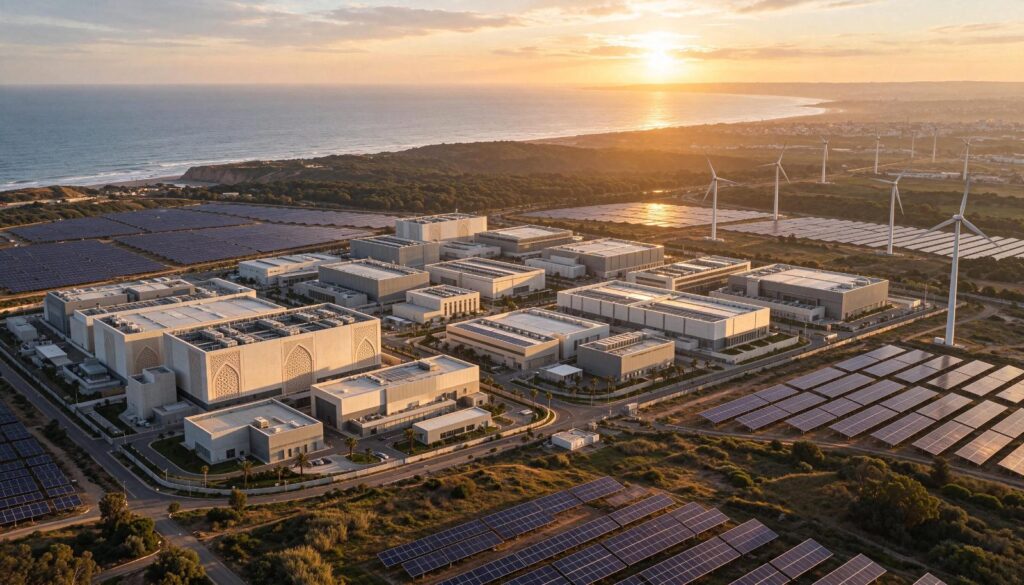
In April 2026, at GITEX Africa in Marrakech, Morocco unveiled the Nexus AI Factory, a project described as Africa’s first sovereign AI infrastructure platform of its kind. Nexus Core Systems signed a memorandum of understanding with Moroccan government agencies for an investment of about 12 billion dirhams, roughly $1.29 billion. The planned facility near Casablanca is built around Nvidia’s Blackwell computing systems, with a target capacity of 500 megawatts powered by renewable energy supplied by TAQA Morocco.
The consortium behind the project illustrates how AI infrastructure is assembled today. Reports describe a partnership linking Nexus Core Systems, Nvidia, the South Korean cloud company Naver and the investment firm Lloyd Capital. Nvidia has clarified that the $1.2 billion is the initial investment planned for the facility, not a direct outlay by the company, whose role is to supply the computing technology.
What “sovereign AI” means for business
Sovereign AI refers to a country’s ability to host, govern and benefit from AI computing on its own terms: data stays under national jurisdiction, public institutions gain access to capacity, and local firms are not wholly dependent on foreign cloud regions. For Morocco, the facility is also positioned as a gateway serving Europe, the Middle East and Africa, combining national ambition with regional commercial strategy.
For managers, sovereign AI projects create a new kind of market. They involve state agencies, foreign technology suppliers, energy producers, investors and local universities, each with different objectives and time horizons. Success depends on contract design, risk allocation, energy pricing and governance as much as on the technology itself.
Skills the next generation of MBAs will need
We believe business schools must prepare students to work inside these complex partnerships. That means teaching:
- Public-private partnership structures, including memoranda of understanding, concession models and the sequencing of public commitments and private capital.
- Energy and infrastructure economics, since a 500-megawatt facility is as much an energy project as a computing project.
- Technology diplomacy, because export controls, data regulation and alliances with American, European and Asian suppliers shape what can be built and who can use it.
- Ecosystem strategy, to ensure that local startups, researchers and public services can actually access the capacity being built.
Between Silicon Valley and the Global South
The Nexus project captures the bridge our MBA programs are designed to build. On one side stands the cutting edge of Silicon Valley technology, in this case Nvidia’s latest systems. On the other stands an African state determined to capture value from AI rather than merely consume it. Between them is a negotiation over capital, energy, data and long-term benefit.
Graduates who understand both sides of that negotiation, the logic of global technology firms and the priorities of sovereign governments, will be among the most valuable leaders of the coming decade. As an intergovernmental university, EUCLID trains professionals to sit on either side of the table, and ideally to help both sides reach agreements that last.
Sources
- Developing Telecoms: Nexus to build US$1.2 billion AI factory in Morocco
- Agenzia Nova: Nvidia confirms two computing infrastructure projects in Morocco
- North Africa Post: Morocco attracts $1.2 billion initial investment for AI factory
aiMBA Insight is published by the EUCLID and EULER MBA programs. Explore our MBA in Artificial Intelligence and Digital Transformation and our other specialized MBAs.