In November 2026, Bloomberg’s Billionaires Index put Aliko Dangote’s net worth at about $39.4 billion, up $4.4 billion from its previous figure. The increase follows the Dangote Refinery’s return to profit, with $4.725 billion in net income for the nine months ended September 30, and the launch of the refinery’s initial public offering on September 14, 2026. Forbes raised its own estimate of Dangote’s wealth to $51.3 billion after the IPO was launched.
Beyond the headlines about personal wealth, these numbers mark a significant moment for African industry. A privately built refinery of continental scale has reached profitability and opened itself to public investors. It shows that large, complex industrial assets can be built and operated in Africa at a global standard.
Where AI enters heavy industry
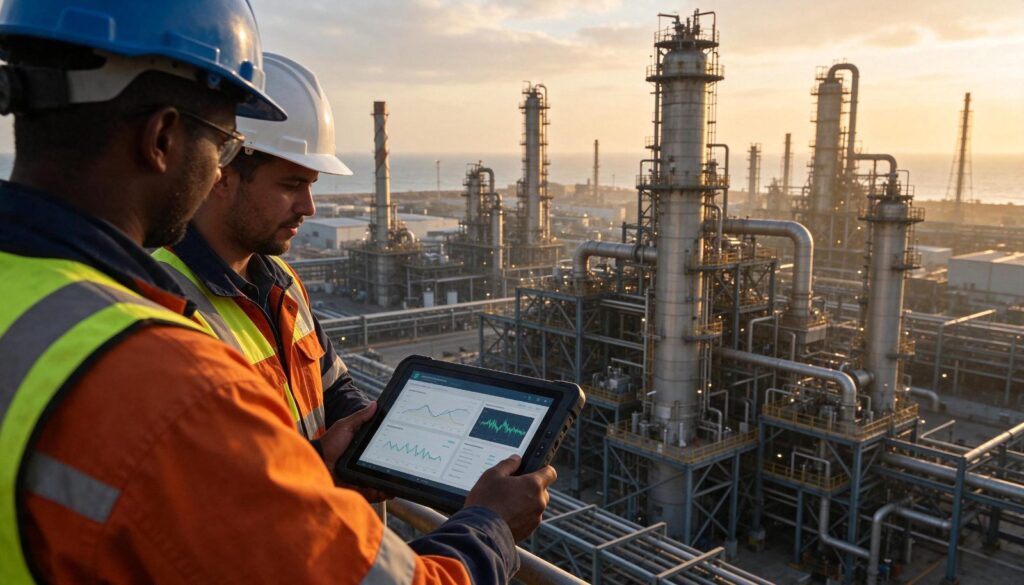
Refineries, cement plants, fertilizer facilities and power stations are among the most data-rich operations in any economy. Sensors measure temperatures, pressures, flows and vibrations continuously. AI can turn that data into value in several ways that are now standard practice among global industrial leaders:
- Predictive maintenance, anticipating equipment failures before they halt production.
- Process optimization, adjusting operating parameters to improve yield and reduce energy use.
- Supply chain planning, forecasting crude supply, product demand and logistics across borders.
- Safety and environmental monitoring, detecting leaks, emissions and hazardous conditions earlier.
For an industrial champion competing with refineries in the Middle East, Europe and Asia, these capabilities are not optional. Margins in refining are thin, and small efficiency gains translate into large sums.
The management challenge
Deploying AI in heavy industry is difficult. It requires reliable data infrastructure, skilled engineers, cybersecurity for operational technology and, above all, managers who can integrate digital tools into plants that run around the clock. It also raises questions about workforce development in communities that depend on industrial employment.
We believe MBA programs must prepare leaders for this environment. Our MBA in Energy Studies combines management and economics with graduate study of oil and petrochemicals, electricity and renewable energy. Our MBA in Artificial Intelligence and Digital Transformation teaches how to lead technology change across large organizations. Together, they reflect what Africa’s industrial champions will need: leaders who understand both the plant and the algorithm.
Public markets, public interest
The refinery’s IPO also matters for governance. Public listing brings disclosure, analyst scrutiny and broader ownership. Investors will expect clear reporting on operations, risks and technology strategy. For policymakers, the success of large private industrial projects raises questions about competition, energy security and regional trade.
As an intergovernmental university, EUCLID trains professionals who will sit on all sides of these questions: in companies, in ministries, in regulators and in international organizations. Africa’s industrial future will be built by people who understand capital markets, public policy and the digital technologies transforming industry worldwide.
Sources
aiMBA Insight is published by the EUCLID and EULER MBA programs. Explore our MBA in Artificial Intelligence and Digital Transformation and our other specialized MBAs.