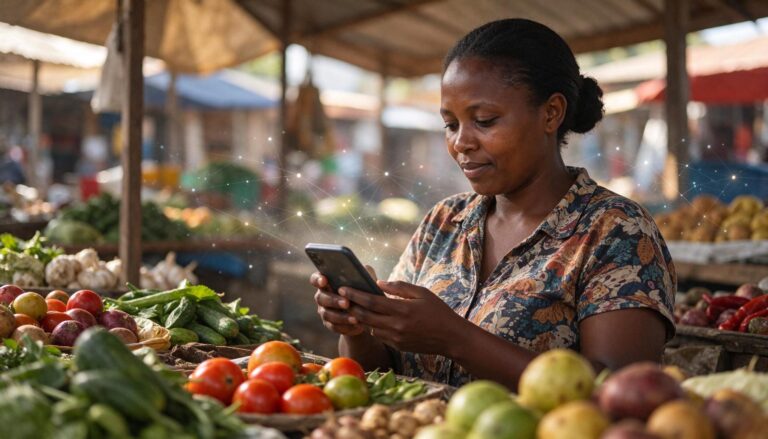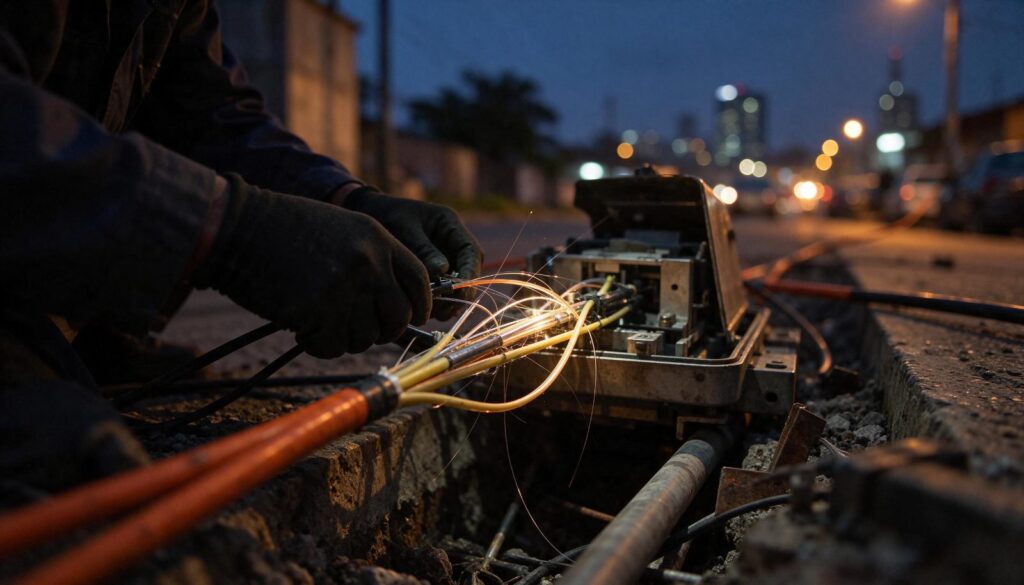
Africa’s artificial intelligence ambitions rest on a surprisingly fragile foundation. At the WBBA Broadband Development Congress Africa 2026 in Cape Town, Huawei Vice President Yongqiang Yuan told delegates that the continent suffers more than 100,000 fiber cuts every year, and speakers warned that a single cut can still knock an entire country offline. The warning echoed South Africa’s Deputy President, Paul Mashatile, who opened the Africa Tech Festival 2026 in the same city last week by naming future-ready digital infrastructure as the first of five priorities for building Africa’s own AI capabilities.
For business leaders, the lesson is direct. We tend to discuss AI in terms of models, data and talent, yet none of these creates value when the connection fails. As Openserve’s Dr Sunil Piyarlall put it in Cape Town, “Intelligence is only as valuable as the connection that carries it.”
Resilience Is a Business Case, Not a Cost Center
According to Yuan, every dollar invested in network resilience saves five dollars in losses. Whatever the precise ratio in a given market, the logic should be familiar to any finance team. Cloud-based AI tools, digital payments and automated supply chains all assume constant connectivity. When a submarine or terrestrial cable is severed, firms lose revenue, customers lose trust, and AI systems that depend on remote data centers simply stop working.
Openserve executive Amu Maja called for a continent-wide terrestrial fiber backbone, arguing that today’s networks remain too dependent on single routes. For investors, this points to a practical question: before funding an AI product for African markets, we should ask how it performs when the network does not.
Power, Data Centers and Local Relevance
Connectivity was not the only constraint on the agenda. Eskom chairman Dr Mteto Nyati told the congress that South Africa now has surplus electricity available for energy-intensive industries, including data centers. Cassava Technologies’ Ziaad Suleman added that Africa must build AI tools that reflect local realities rather than importing models designed for other markets.
At the Africa Tech Festival, which drew more than 15,000 delegates to the Cape Town International Convention Centre, Mashatile set out a broader agenda. His five priorities covered infrastructure, digital skills, the commercialization of African innovation, cybersecurity and responsible AI governance, and regional integration. In his words, “We will compete by solving our own challenges.”
What MBA Programs Must Teach
Managers who deploy AI in the Global South need skills that standard technology courses rarely cover. In our view, MBA programs should prepare students to:
- Build business continuity plans for AI services that assume outages, with offline modes, edge computing and fallback processes;
- Evaluate infrastructure risk, including fiber routes, power supply and data center location, as part of every AI investment decision;
- Calculate the return on resilience spending and present it to boards as risk reduction rather than overhead;
- Negotiate service agreements with telecom operators and cloud providers that include redundancy and clear recovery times;
- Design AI products around local data, languages and conditions, as speakers in Cape Town urged;
- Work with regulators and regional bodies on cross-border infrastructure, since a continental backbone requires cooperation between States.
Bridging Silicon Valley and the Global South
Silicon Valley builds AI for a world of near-perfect connectivity. Much of the Global South does not live in that world yet, and its managers cannot afford to pretend otherwise. As intergovernmental institutions established by treaty between sovereign States, EUCLID and EULER are well placed to bridge that gap. Through our MBA programs, we aim to connect frontier technology with the infrastructure, policy and regional cooperation that make it work on the ground, so that Africa’s AI future is built on networks strong enough to carry it.
Sources
- Faizel Patel, “Africa’s AI dreams at risk as 100,000 annual fibre cuts expose broadband weakness,” The Citizen, November 23, 2026
- “South Africa’s Deputy President, H.E. Paul Mashatile Urges Africa to Build its Own AI Capabilities,” PC Tech Magazine, November 18, 2026
aiMBA Insight is published by the EUCLID and EULER MBA programs. Explore our MBA in Artificial Intelligence and Digital Transformation and our other specialized MBAs.