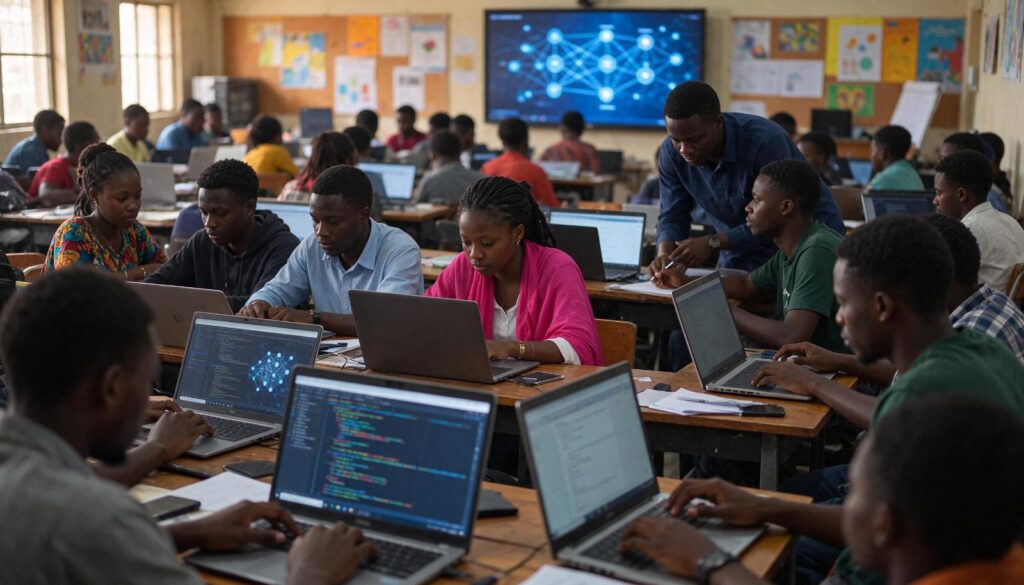
In late October 2026, Talent Nation, an AI engineering talent platform founded by Nigerian entrepreneur Iyinoluwa Aboyeji and South African entrepreneur Kesiah Valkin, announced an undisclosed pre-seed round co-led by Enza Capital and LocalGlobe. Future Africa, Kaleo Ventures, Ajim Capital, Solving.org and Accelerate Africa also participated. The company’s stated goal is to train, certify and place one million African AI engineers with businesses around the world over the next decade.
Talent Nation builds on Learn2Earn, a training academy Aboyeji founded that has operated for about 18 months. Analysts quoted in coverage of the round note that scaling from roughly 1,400 enrolled fellows to one million working engineers would be an unprecedented operational challenge.
Africa’s demographic advantage meets AI demand
The logic behind the bet is clear. Global demand for AI engineering skills far exceeds supply, while Africa has the world’s youngest and fastest-growing workforce. Rather than competing for a scarce pool of engineers in a few expensive cities, companies can help expand the pool itself. Aboyeji has done something similar before as a co-founder of Andela and Flutterwave, two of the continent’s best-known technology companies.
The same logic appears in other initiatives this month. On November 9, Google.org’s AI Research Foundations program launched in South Africa, hosted by Stellenbosch University’s Centre for Epidemic Response and Innovation with the African Institute for Mathematical Sciences.
Engineers need managers who understand AI
Training engineers is only half of the equation. Organizations that hire AI talent, whether in Lagos or in London, need managers who can define problems worth solving, set priorities, evaluate results and integrate AI systems into operations. Distributed teams spanning several continents also require skills in remote leadership, cross-cultural communication and quality assurance.
We believe MBA programs should prepare students for this new division of labor. Graduates should know enough about AI to ask the right questions and judge the answers, even if they never write code themselves. They should understand talent markets, global delivery models and the economics of building versus buying AI capability. They should also be ready to lead teams in which engineers in Nairobi, Kigali or Accra work with product owners in Silicon Valley and clients in Europe.
A shared agenda for the Global South
For governments, the question is how to ensure that talent programs create lasting national capacity rather than a one-way export of skills. Policies on education, digital infrastructure, taxation of remote work and recognition of qualifications all play a role. Nigeria’s 3 Million Technical Talent initiative, on whose advisory committee Aboyeji serves, is one example of public and private efforts converging.
EUCLID’s mission includes training leaders for the Global South, and our MBA in Artificial Intelligence and Digital Transformation was designed for professionals who will manage this convergence of technology, talent and public policy. If Africa trains a million AI engineers, it will also need tens of thousands of managers capable of turning their work into businesses, public services and economic growth.
Sources
- Fundz: Talent Nation pre-seed funding round
- AF.NET: Talent Nation secures pre-seed funding
- AF.NET: Talent Nation secures pre-seed funding to train and place African AI engineers
- AIERA: Talent Nation, 1 million African AI engineers planned
- Innovation Village: AI Africa Intelligence, November 5 to 11, 2026
aiMBA Insight is published by the EUCLID and EULER MBA programs. Explore our MBA in Artificial Intelligence and Digital Transformation and our other specialized MBAs.